From paper rotas to live data: scheduling software in action
by Annabel Beales on 22 January 2026
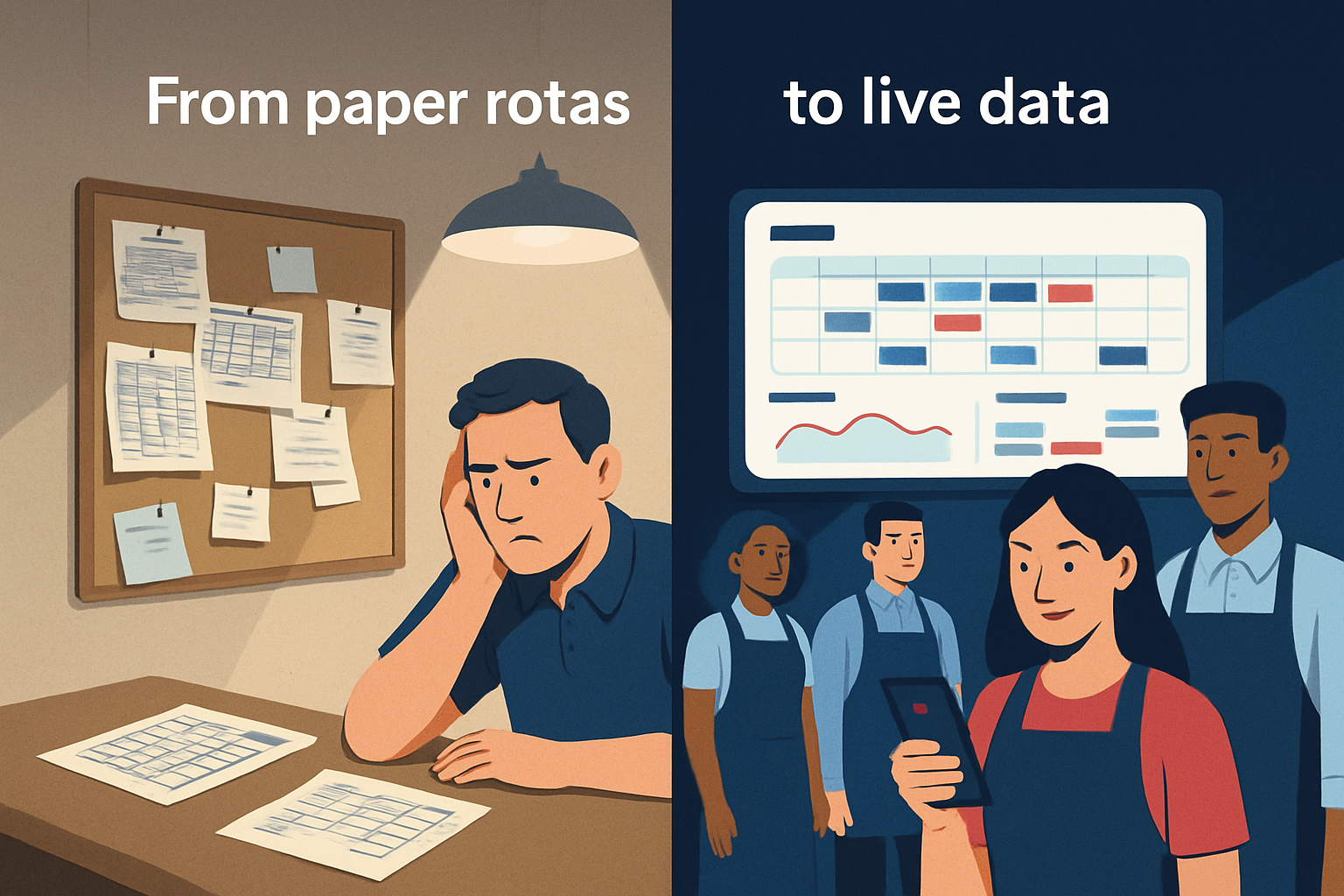
Adaptability is the new advantage - and it has to start with the systems behind the rota.
This series, based on panel insights from Caffè Nero, William Hill, and The Entertainer, explores how leading brands are moving beyond manual scheduling.
Part 1 looked at the workforce trends reshaping retail and hospitality; Part 2 explores what operators can do next, and why adaptive scheduling software is becoming essential.
Manual scheduling systems were built for stability, not volatility
Traditional rota systems were designed for predictable trading patterns and struggle when demand changes rapidly.
|
“You’d have a laminated sheet at the back of a shop on a notice board. Some people would do it on an Excel spreadsheet. Some people would be purely pen and paper - because they’d done it the same way for 30 years.” |
Local scheduling habits limit visibility and consistency
Routine and manual, these processes described by Thomas George, Head of Business Insight at William Hill, were shaped by local habits, not shared visibility.
Workforce volatility exposes the limits of manual processes
Rising demand volatility has made manual scheduling increasingly difficult to sustain in retail and hospitality.
For years, this approach worked well enough for retail and hospitality businesses across the UK. But the volatility these industries now operate in has exposed its limits in the real world.
Being able to adapt is now essential, and when manual systems can’t keep up, they create pressure for managers and inconsistency for team members. What used to be basic rota-building is becoming real-time workforce planning.
Moving from rigid, pen-and-paper rotas to flexible, digital systems requires consistency, visibility, and the ability to flex with demand - something traditional tools weren’t built for, but modern planning software can support.
It’s a shift many operators are now prioritising, and the foundation for workforce models that can respond to the pace of change.
The hidden cost of pen and paper
When talking about how workforce management worked prior to Rotageek, all three leaders described similar workforce management habits: an approach that relied heavily on pen-and-paper processes, store-by-store habits, and tools that simply weren’t built for the realities retail and hospitality now face.
Local rotas limit oversight
At William Hill, rotas lived wherever individual managers put them, and as a result, Thomas described head office having “no [full] visibility of costs until the P&Ls landed at the end of the month.”
Financial data arrives too late
By the time data reached central finance or ERP systems, it was already too late to intervene. At that point, labour costs are already locked in, leaving little room to adjust.
Time data is unreliable
At The Entertainer, the picture was similarly fragmented.
Indre Lapiene, Reward Manager, described stores “relying on a trust system… the employees were not clocking in and out,” which meant managers had no accurate view of actual working hours and payroll had no reliable record of hours worked or clean data flowing into payroll systems. The downstream impact: “half of their job was producing reports… it led to loads of mistakes.”
Managers absorb the pressure
Andy Maynard, IT Director at Caffe Nero, drew from his years in hospitality when talking about the challenges of managing staffing manually across multiple channels and operating models. Teams were stretched, and without consistent visibility or predictable patterns, colleagues could end up overwhelmed - a pressure he’s witnessed firsthand.
Systems operate in silos
When scheduling lives in spreadsheets, notebooks, or isolated systems instead of a shared rota system that links teams and data together, leaders can’t see what’s really happening. Work gets trapped in silos, and teams feel the consequences. Errors creep in, payroll becomes reactive, managers lose time, and colleagues lose trust in how rotas are built.
Situations like these become harder to sustain as demand grows more variable and teams run leaner, which is why more operators are now stepping back to reassess the true cost of manual scheduling.
The next section explores what modern, adaptive systems offer in return: consistency, visibility, and the ability to flex with demand.
3 ways modern scheduling software transforms operations
Event poll: what’s changed in workforce management so far
54% of leaders say the biggest leap has been employee self-service and mobile access including the ability for teams to self schedule appointments and manage availability digitally. And 27% point to smarter forecasting. Only 13% cite data-driven decision making, and just 4% highlight fairer scheduling or compliance tracking.
What this shows: progress on access and usability, but a clear gap when it comes to deeper workforce management transformation - the shift to adaptive, data-led, human-centred scheduling.
It’s exactly this gap that led William Hill, The Entertainer, and Caffè Nero to move to an adaptive scheduling approach with Rotageek, using software functions designed to fundamentally change how demand, cost, and fairness are balanced day to day.
👉 Download the workforce transformation report
1. Centralised visibility
From local rotas to shared oversight
Bringing every site onto a single, shared system can have an immediate impact. For William Hill, that meant moving away from rotas that lived wherever managers put them and towards what Thomas described as “finally having central oversight” after a world with “no visibility of costs until the P&Ls landed at the end of the month.”
This shift gives central teams a clearer real time view of what’s happening across locations, helping them understand where resources are being used and where pressure is building.
One version of the truth across teams
At The Entertainer, the shift had a similar effect. Indre explained that “our operations team, L&D, and finance have access – everyone can run reports and double-check things”.
Local spreadsheets have been replaced with shared dashboards and a single version of the truth that all stakeholders can trust. Instead of relying on updates passed between systems or stored on a local website, teams can see the same information at the same time.
Clearer conversations, fewer surprises
With everyone working from the same real-time data, surprises are reduced and conversations between stores and central teams become far clearer. Decisions are based on shared information rather than assumptions, making it a lot easier to spot issues early and respond before they escalate.
2. Predictability for teams
Seeing rotas earlier, with time to plan
Modern scheduling software changes how far ahead people can see, using real time availability to help managers adjust when plans need to change. Andy Maynard explained the human impact of this new approach: “They’re no longer waiting for their store manager to produce the rota on a Sunday night… they’re now getting rotas three weeks out in advance and seeing it on their phone”, moving away from relying on notice boards, a shared booking page or last-minute scheduling as the default.
Automated reminders also help reduce missed shifts and last-minute confusion, giving each person more certainty about the date, time and location of their shifts.
More agency on the shop floor
For The Entertainer, visibility translated into more agency on the shop floor. “They see what was planned, what their duty manager is expecting to see… staff have power now,” Indre said.
With clearer plans and expectations, teams can organise their time better and feel more in control of their working week, helping teams manage the personal logistics of their working week.
Clearer expectations support better outcomes
When adaptive planning lets colleagues see what’s coming on time and understand expectations, the rota becomes something they can rely on rather than react to - with workload spread more evenly across the team.
When rotas are clearer and easier to adjust, both service levels and performance improve, alongside team wellbeing.
3. Fewer errors and tighter financial control
Errors fixed early, not after the fact
For William Hill, the move away from manual scheduling had a clear financial impact. Thomas shared that once the new system was in place, “the amount of errors [fixed]… was enough to pay for the whole project by itself.”
By catching issues earlier in the process, teams reduce the knock-on effects that typically appear in payroll and reporting at month end.
Less rework for payroll and finance
The Entertainer saw something similar. Before introducing adaptive tools, payroll teams spent huge amounts of time fixing issues. With automated reporting and cleaner data, workflows become less time-consuming, financial planning becomes easier, and finance teams spend less time chasing invoices.
This shift allows finance teams to focus on higher-value work rather than constant corrections.
Better data supports confident decisions
When errors reduce and data becomes reliable, teams streamline admin time, boost productivity, and remove bottlenecks. Managers gain confidence in the metrics, and the organisation gains a firmer grip on costs.
Over time, this clarity supports healthier revenue performance by protecting margins and reducing avoidable leakage - without placing additional pressure on teams.
Choosing rota software: checklist
From the panel’s experience, three elements mattered most when choosing retail workforce management software that genuinely works for retail and hospitality:
-
Visibility everyone can trust: one version of the truth across stores, payroll, and operations, so issues surface early and conversations stay clear.
-
Predictability for teams: rotas published earlier, clearer patterns, and the flexibility to adjust when demand shifts. Clear schedules also reduce unnecessary contact between managers and teams outside working hours
-
Accuracy without admin: clean time data, fewer fixes, and reporting powered by automation that frees people from spreadsheets.
These foundations make adaptability possible day to day in the real environments where colleagues work and customers are served.
A more adaptable way to plan work
What stands out from the panel is that modern scheduling is a control system for volatility. When scheduling is based on real demand and shared scheduling rules, leaders stop reacting and start steering - creating the conditions for continuous improvement and skills development rather than constant firefighting.
Colleagues get the predictability they need to stay engaged, and paid downtime shrinks as schedules track real demand more closely.
AI-powered scheduling software is what enables that change, but it doesn’t deliver it alone. The real transformation comes from how people use it - the confidence to trust the data, the willingness to rethink old routines and the support they get as new habits take hold.
With clearer data and fewer last-minute changes, teams save time and focus on running the operation
And that’s exactly where we’re heading next. Blog 3 explores the people side of adaptability: how to bring teams with you, what helps adoption stick, and why the most successful workforce strategies start with culture, not technology.
See how Rotageek helps multi-site brands move from manual rotas to adaptive, AI-driven scheduling, and download the full ‘Ready for anything’ report for more examples and data.
👉 Download the workforce transformation report