Workforce management software: put your data where decisions happen
by Annabel Beales on 2 April 2026
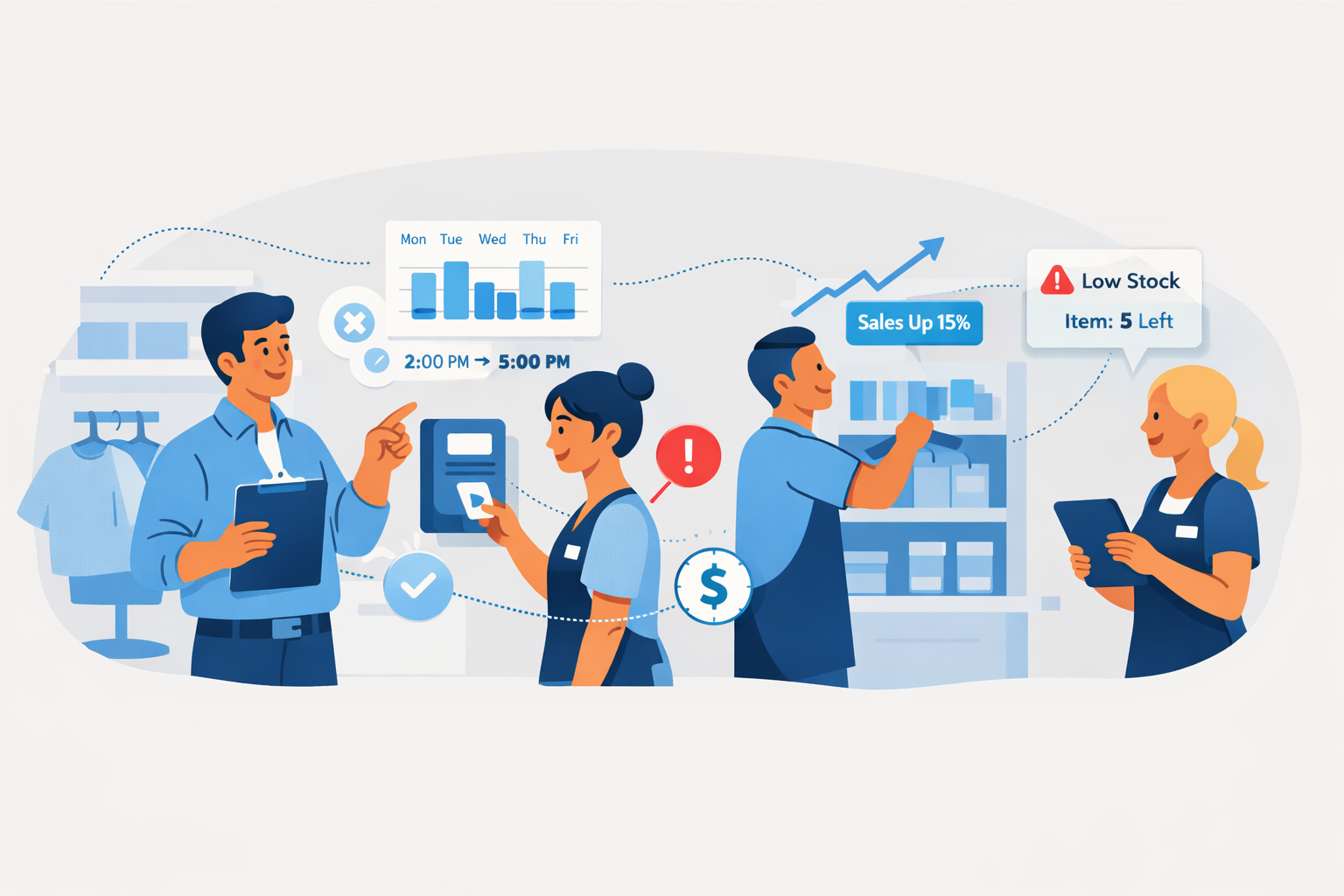
Workforce management tools have transformed workforce planning - but planning is only half the story. This series is about how connecting strategic workforce planning with execution and insight will let you make faster, better decisions across your entire operation and protect future growth.
In this series:
- Blog 1: Is your workforce management plan costing you more than it should?
- Blog 2: Your workforce management challenges aren't a planning problem
- Blog 3: Workforce management reporting: seeing vs fixing the problem
Your CFO stops by your desk. They want to know which regions are running over labour budget this week - right now, before the meeting that starts in ten minutes.
Before, your heart would have sunk. You'd have known what was coming: telling your CFO you can’t find the answer that quickly, pulling data from three different places, spending the afternoon in a spreadsheet, and finally getting to an answer too late.
Today, you already know what you’re going to say. You walk into that meeting with the numbers, and the conversation that follows is about next steps, not trying to figure out what’s been going on.
So, what changed?
That answer - the one that turned your meeting from damage control to forward planning - came from an embedded analytics solution already running across your operation, connecting what's happening on your shop floors to the numbers on your screen to the decisions you make day-to-day.
Let’s find out more - by rewinding the clock to yesterday.
When seeing the problem and fixing it become the same thing
Something doesn't feel right. Labour spend across the North region is tracking higher than budgeted and, with payroll costs already under pressure, every percentage point of variance matters. You're not sure which sites are driving it, or why. But you know you need to find out before it goes any further.
A few months ago, you’d have to do your best with what data analysis was available. You’d make a few calls, piece together what you could from the reports available, maybe request a new one from your data analysts…from there, you’d have to interpret data and figure out how to translate it into next week’s plan.
From business intelligence to data-driven decisions
With Rotageek, getting and acting on the insight you need is a lot more simple. You open the platform - where your schedules also live - and start digging. The system surfaces the data most relevant to what you're looking for, and prompts you towards the questions worth asking.
Within minutes you're looking at labour spend broken down across your seven sites, with variance to budget visible against each one. One site is running 8% over for the week; enough to make an impact on your regional P&L. In natural language, you ask what’s driving it.
The answer comes back immediately. Three things are happening simultaneously:
- The morning shift has low staffing levels during a demand spike, pulling in overtime at a premium rate to cover it
- The evening shift has scheduled hours running ahead of actuals; ghost hours that are eating into your payroll budget unnoticed
- One shift is approaching a working time threshold - miss it, and it’ll be an expensive compliance breach
You’ve found three problems in one go and, more importantly, you have enough of the week left to act on all of them. The schedule is right there, and you’re able to adjust shifts, resolve your compliance risk, and stop the unplanned spend on the spot. The regional margin stays protected, rather than being written off at month end.
The next morning, when your CFO asks which regions are over budget, you already have the answer. And more importantly, you’ve already done something about it.
This is what Rotageek is built to do: connect insight to execution, so that seeing a problem in workforce management reporting and fixing it happen in the same place, at the same time. Not a faster version of your old workflow, but a fundamentally different one.
The embedded analytics solution your people have been waiting for
The operational change we've just described doesn't stay at senior level. When insight lives inside the system where workforce decisions get made, it changes how every team member works from the shop floor up.
When the rota reflects reality
For the frontline worker, the change is felt less in data and more in experience. Schedules reflect reality rather than a best guess. Changes are communicated with enough notice to plan around. And with fewer last-minute disruptions, employees have greater certainty about the week ahead - supporting both their financial and emotional wellbeing.
The store manager who stops firefighting
For store managers, getting data has historically meant navigating requests and making calls under pressure without the full picture. Frontline managers already carry the heaviest load, and adding to it risks burnout and disengagement.
When insight lives inside execution, however, they’re better equipped to handle what the floor throws at them.
The manager who has a hunch that something is off can make data-driven decisions immediately. And when their local knowledge leads them to make a call that diverges from the plan, that intelligence gets captured, tested, and fed back into the system.
Some businesses give their store managers significant autonomy; the freedom to run their patch, test ideas, and make informed decisions based on what they know about their location and their customers. Others maintain tighter central control.
When insight is governed by role, both approaches get what they need and the people closest to the customer have what they need to do their job well, whatever that looks like in practice.
The regional team that can actually see across its patch
For regional teams, Rotageek surfaces patterns across every site - one location consistently underperforming on conversion, another where absence spikes regularly - in the same central place where schedules are managed. Good solutions that work at one site get spotted, shared, and acted on by all internal users, rather than staying local.
What this means for employee performance and wellbeing
There's a human dimension to all of this that doesn't show up in labour variance reports.
When people have what they need to do their jobs well, like clear schedules, data at the point of decision, less time spent firefighting and more time spent actually managing, the difference shows up in staff NPS as much as it does in labour costs.
When working experience improves alongside the operational one, you’ll improve employee engagement alongside workforce performance, and top talent is more likely to stay.
Increased employee retention continues to have a significant impact on the bottom line - and today, when margins are already razor-thin, this can make the difference between getting ahead and falling behind.
What workforce planning leaders can change now
to get ahead of hidden risks - a senior panel discussion
Watch on demandThe beginning of a better business strategy
Connecting insight to execution doesn't just change what you can see. It changes what you can do - and who in your business gets to do it.
This change has implications that go well beyond day-to-day labour management. Organisations that close the loop between workforce planning, execution, and insight don’t just run more data-driven operations - they build a measurable competitive advantage.
Coming up next: what decision-led workforce management looks like as a long-term business strategy, and why it's becoming a key advantage for the businesses that get there first.
FAQs
What is the difference between workforce analytics and workforce management software?
Workforce management software handles scheduling, forecasting, and compliance. Workforce analytics turns that operational data into insight. The most effective platforms combine both, so that insight is available inside the system where decisions get made rather than in a separate tool.
Why does real-time labour cost tracking matter for multi-site operations?
In multi-site operations, small variances add up quickly. Real-time labour cost tracking makes overtime exposure, budget variance, and schedule discrepancies visible while the week is still live, giving operations teams the opportunity to intervene before costs are committed.
What are embedded analytics in workforce management?
Embedded analytics means insight lives inside the workforce management platform rather than in a separate BI tool. Because data analytics and scheduling exist in the same system, teams can identify a problem and act on it in a single workflow, without switching platforms or waiting for a report.
How does workforce management software improve labour cost visibility?
Labour cost visibility improves when scheduled hours, actual hours, and budget data are connected in real time. Rotageek surfaces variance to budget, overtime risk, and ghost hours as they build, so finance and operations leaders can act before costs impact the P&L rather than after.
What is workforce decision-making in the context of multi-site operations?
Workforce decision-making in multi-site operations means giving every level of the business access to the right data at the right moment. When insight is governed by role and embedded in execution, decisions get made with evidence rather than instinct, across every site, every day.
Why is embedded analytics important for workforce management?
Embedded analytics removes the gap between insight and action. When data-driven insights live inside your workforce management platform, teams don't need to switch tools or wait for reports. Instead, they can act immediately. The embedding capabilities of modern workforce software directly increase productivity by putting the right information in the right hands at the right moment.

Rota Geek Limited is a company registered in England and Wales with the company number 06783810 and registered address of Unit 6 & 7, Foundry Court, Foundry Lane, Horsham, West Sussex, England, RH13 5PY


- Quick links
- Log In
- Book a Demo
- Help Centre
- Products
- Digital Scheduling
- Autoscheduling
- Forecasting
- Company
- Our Story
- Careers
- Blog
- Privacy Policy