• Support
  • Login
  • Solutions

    Digital Scheduling

    A core workforce management solution for rota planning that simple and smart.

    Explore >
    Add Ons
    • Digital Scheduling A core workforce management solution for rota planning that’s simple and smart.
    • Add-Ons
    • Forecasting See tomorrow today with predictive insights into your demand spikes.
    • Labour Modelling Connect demand forecasts into precise, deployable staff rotas.
    • Auto Scheduling Generate optimised, compliant, fair schedules in seconds — not hours.
    • AI Insights Ask questions in natural language and get instant, AI-backed answers without BI backlogs.
    • HR powered by ELMO Discover a connected HR and workforce platform with ELMO solutions.

    Take a self guided product tour

    Start >
    Book a demo Speak to a Geek
  • Features
    Features
    • View All Features View all of our workforce management solutions
    • Shift Planning Plan shifts using our digital scheduling software
    • Mobile App - Employee Engagement Improve communication and create a transparent approach to scheduling for your workforce.
    • Clocking In/Out Manage employee schedules and clock in and out for shifts
    • Leave & Absence Management Request, approve, and track leave and absence for your workforce from one solution.
    • Timesheet Tracking & Attendance Manage hours scheduled vs hours worked and automatically create timesheets to send to payroll
    • Insights & Reporting Customisable reporting to track the workforce metrics that matter.
    • Integrations Integrate our workforce management solutions and schedules into other tech seamlessly

    Watch a 6 minute demo

    Watch >
    Book a demo Speak to a Geek
  • Industries
    Industries
    • View All Industries View all of our industries
    • Retail Helping retailers spend 1:1 time with customers - not the rota.
    • Hospitality Serving the hospitality industry with first-class rotas.
    • Entertainment & Leisure Game-changing scheduling as engaging as your business.
    • Healthcare Whether you're a private service or large trust, Rotageek is here to help.
    • Care Homes Working with care and nursing homes to provide optimal rota solutions.
    • Other Sectors Helping a host of workforces to meet fluctuating demand.

    Scheduling & Workforce Management RFP Template

    Download >
    Book a demo Speak to a Geek
  • Customer Stories
  • Resources
    Resources
    • Free Downloads From white papers to webinars, we've got you covered.
    • Blog All the latest industry insights from the Geeks.
    • Scheduling Impact Analysis See what better scheduling could be worth by using your existing schedules and transaction data.
    • Watch the latest on-demand webinar Peak without panic: workforce planning in multi-peak retail
    • Retail Insights Hub Retail trends, reports and expert content

    Scheduling & Workforce Management RFP Template

    Download >
    Book a demo Speak to a Geek
  • About Us
    About Us
    • Why Rotageek? What makes us a different type of scheduling solution?
    • Moving to Rotageek Live your best scheduling life when you move to Rotageek.
    • Partners Our partner ecosystem to supercharge your scheduling solution.
    • Our Story The Rotageek story so far.
    • Meet The Team The Geeks behind the scenes.
    • Careers Meet the team and become a rota geek.
    • Contact Us Get in touch and speak to a geek.

    Watch a 6 minute demo

    Watch >
    Book a demo Speak to a Geek
  • Product Tour
  • Book a Demo

How much value are your schedules leaving on the table?

A 5-minute retail scheduling diagnostic

Start your assessment
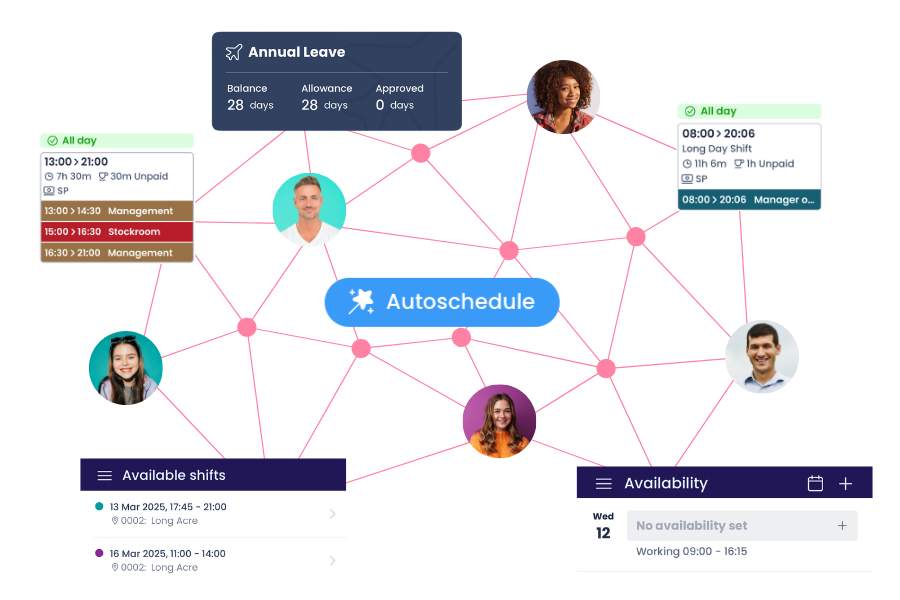
Autoscheduling Apr 25-1


Whether you're a single-site retailer or managing teams across dozens of stores, the pressure to run a more productive and profitable operation has never been greater.

These changing operating conditions don’t create workforce planning challenges. They reveal them (and the opportunities you could be missing).

And for most retailers, scheduling decisions are still made reactively - leaving real value on the table without anyone knowing where to look. Until now.

So what happens when reactivity becomes the norm rather than the exception?

The question is whether that reactivity is limiting performance, increasing complexity or leaving value untapped.

Effective workforce planning is no longer just an operational process. It's becoming an increasingly important part of retail business strategy as organisations look to improve productivity, support growth and deliver better operational outcomes.

This short assessment is designed to help workforce management leaders understand where workforce planning is creating value - and where more opportunity may exist.

71%
of retailers schedule reactively
Find out what it's costing you.
5 mins
to complete this diagnostic
and understand your opportunity
Free
scheduling impact analysis
using your own data and schedules
Start the diagnostic

or scroll to learn more about the Scheduling Impact Analysis

In less than 5 minutes, assess:

✓ Workforce visibility

✓ Manager effectiveness

✓ Employee experience

✓ Customer impact

✓ Workforce planning opportunity

Start now

Rate how much you agree with each statement. Your total score will reveal where wasted hours, coverage gaps and rota admin may be limiting your operation — and whether a Scheduling Impact Analysis could help you find them.

0 of 15 rated

Your score

0 out of 75

You’ve seen the gaps. Here’s how to find them in your data

Most retailers already have everything they need to identify where scheduling is limiting performance. The Scheduling Impact Analysis uses your existing schedules and transaction data to turn what you've just identified into a clear picture of where the opportunity sits - and what it could be worth.

What you’ll get

A clear view of where hours are being spent at the wrong times
Where rota admin is getting in the way of managing
Where understaffed peaks and overstaffed quiet periods are costing you
An estimate of the potential commercial impact of improvements
A prioritised view of where to act first - week by week, store by store
Book your scheduling impact analysis

No integration required. No implementation. No disruption to your operation.

Using your own data, we'll show you exactly what your schedules are already telling you - and where the greatest opportunity lies.

FAQs

  • What is a Scheduling Impact Analysis?

    A Scheduling Impact Analysis is a complimentary assessment developed by Rotageek to help retailers understand how workforce planning decisions influence operational performance.

    Using schedule and transaction data, it identifies opportunities relating to labour deployment, demand coverage, manager effectiveness and potential commercial impact.

    The goal is to help retailers understand where value may exist within their operation, improve the quality of workforce planning decisions and identify where improvements could have the greatest impact. The output is a clear view of the opportunities most likely to improve operational performance and business outcomes.

  • What causes reactive scheduling?

    Reactive scheduling often occurs when workforce planning decisions are made in response to immediate staffing challenges rather than forecasted demand. Common causes include changing customer demand, absence management, labour shortages and limited visibility into workforce performance. At Rotageek, we've found that many retailers accept reactivity as part of day-to-day operations without fully understanding the impact it may be having on performance, managers and customer experience.

  • How can retailers improve workforce planning?

    Improving workforce planning starts with visibility. Retailers need to understand customer demand patterns, labour deployment, manager workload and operational performance before identifying where opportunities exist. At Rotageek, we often see that the greatest opportunities aren't always where retailers expect them to be.

    Combining workforce data, operational knowledge and proven planning methods can help organisations make more confident decisions and unlock significant operational value.

  • Why is workforce planning becoming more important in the retail industry?

    Workforce planning is becoming increasingly important across the retail industry as labour costs rise, customer expectations evolve and consumer demand becomes more difficult to predict. Retailers are looking for ways to improve productivity, support employee experience and create greater value from existing labour investment. As one of the largest employers in many economies, the retail industry faces increasing pressure to balance employee experience, customer expectations and operational performance.

  • How are workforce planning practices changing?

    Retail workforce planning practices are evolving as labour costs rise, customer expectations change and the labour market becomes more competitive. Many retailers are moving away from manual scheduling methods and adopting data-led approaches that provide greater visibility into workforce performance. These practices help organisations make more informed decisions and identify opportunities to improve productivity and operational outcomes.

  • What is labour deployment?

    Labour deployment refers to how workforce hours are allocated across stores, teams and trading periods. The challenge isn't simply how much labour a retailer has available, but whether labour is being deployed where customer demand exists and where it can create the greatest value. At Rotageek, we see labour deployment as one of the biggest opportunities for retailers looking to improve operational performance, labour productivity and business outcomes without increasing labour spend.

  • What is workforce optimisation?

    Workforce optimisation is the process of aligning labour resources, employee skills and customer demand to improve operational performance. In retail, workforce optimisation helps organisations make better workforce planning decisions, improve labour productivity and create greater value from existing labour investment. The goal is not simply to reduce labour costs, but to ensure labour is deployed where it can have the greatest impact.

No FAQs match your search.

Rota Geek Limited is a company registered in England and Wales with the company number 06783810 and registered address of Unit 6 & 7, Foundry Court, Foundry Lane, Horsham, West Sussex, England, RH13 5PY


  • Google Play
  • Apple App Store
  • Quick links
  • Log In
  • Book a Demo
  • Help Centre
  • Products
  • Digital Scheduling
  • Autoscheduling
  • Forecasting
  • Company
  • Our Story
  • Careers
  • Blog
  • Privacy Policy
© 2026 Rotageek. All rights reserved.
  • Cookie Policy
  • Privacy Policy