How AI workforce management software turns labour into a growth lever
by Annabel Beales on 9 April 2026
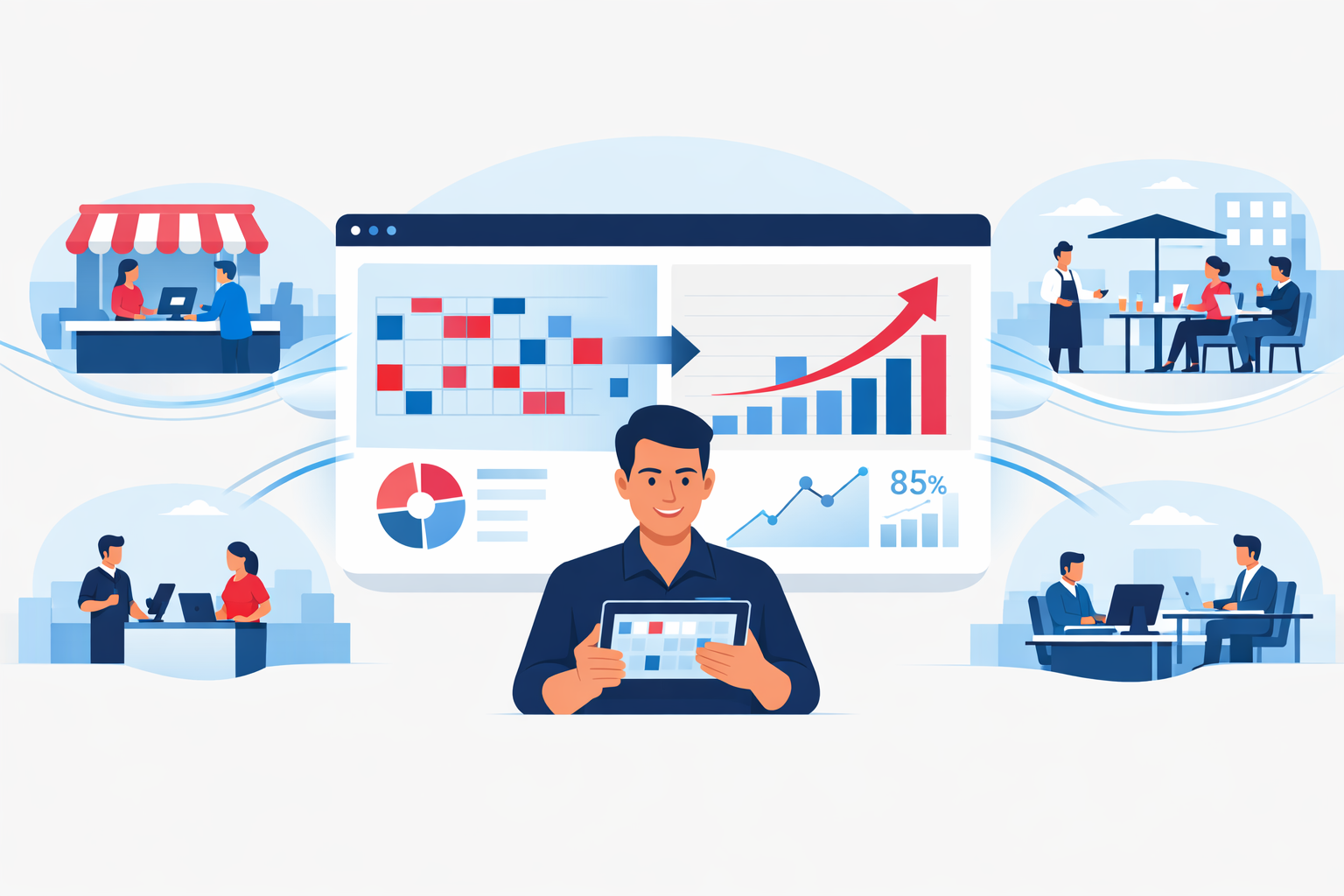
Workforce management tools have transformed workforce planning - but planning is only half the story. This series is about how connecting strategic workforce planning with execution and insight will let you make faster, better decisions across your entire operation and protect future growth.
In this series:
- Blog 1: Is your workforce management plan costing more than it should?
- Blog 2: Your workforce management challenges aren't a planning problem
- Blog 3: Workforce management reporting: seeing vs fixing the problem
- Blog 4: Workforce management software: put your data where decisions happen
We've all been there: the labour report lands, and despite your best efforts to reduce costs, the numbers aren't quite where they should be. You've tightened the forecast, pushed back on agency spend, managed the rota down to the hour and the task - and it still feels like something's being left on the table. Now what?
The pressure we’re under isn't going away. UK profit margins have fallen from 9.1% to 8.5% over the last two decades, and the April 2026 National Living Wage rise is still to land. Every labour hour is more expensive than it was, and the room to absorb variance is shrinking.
Labour costs now account for just over half of national income. It’s a big cost to manage - but managing labour defensively is only going to get you so far. Instead, we’re here to ask a different question: what if, instead, you treat it as your biggest growth lever?
The businesses getting ahead right now are approaching workforce management differently. Instead of only asking how to spend less on labour, they're also asking how to make labour work harder for them and drive productivity - and they're using AI-powered tools like Rotageek to answer that question properly.
Let’s take a closer look:
How AI workforce management turns a cost into a compounding advantage
AI analytics: how your whole operation learns at once
The difference between defending your labour spend and directing it
How AI scheduling helps you boost productivity and pull ahead
The key benefits of closing the workforce planning loop
The growth lever was always there. Now's the time to pull it
How AI workforce management turns a cost into a compounding advantage
Picture this: for a couple of weeks, you're over-scheduled on Thursday afternoons. Not dramatically, but slightly more coverage than the plan strictly calls for. And every Thursday afternoon, customer revenue ticks up. It happens again the following week. And the week after that.
If workforce management is only ever seen as a cost-watching mechanism, the instinct after seeing that over-scheduled Thursday would be to reduce shift numbers. But connect the two data points and something more interesting emerges: a growth opportunity hiding inside what looked like inefficiency.
Rotageek Insights - the embedded analytics layer inside the Rotageek platform - makes that connection possible. Its advanced features turn your scheduling data into live, actionable intelligence in your existing systems, without support from a BI team, manual work, a separate tool, or having to wait in a reporting queue.
Users can ask a question in natural language - "do Thursday afternoon sales increase when I'm over-scheduled?", for example - and Rotageek Insights will surface AI-backed answers in seconds, so users can save time on reporting and act on what they find without leaving the platform. No data skills needed.
You gain insights that confirm your hunch. You build it into the forecast. This changes the next schedule, which leads to more revenue, which refines the forecast again. Each decision informs the next one, with the system tracking performance across every cycle. With AI forecasting, that loop gets tighter every time.
As a result, the gap between what you planned and what actually happens gets narrower every week. You’ve closed the loop between planning, execution, and insight, and labour becomes a lever to pull as well as a cost to be managed.
AI analytics: how your whole operation learns at once
Now picture the same scenario across multiple sites. Every site is running the loop simultaneously, and learning locally:
- Site A confirms that Thursday afternoons with higher coverage drive more revenue, and builds the learning into next week’s plan automatically
- Site B's manager sees the insight in a self-serve dashboard shared by Site A, and decides to experiment with the same adjustment to working hours right away
- Site C optimises schedules in the same way - but has an attendance issue flagged in real time. The manager then has enough time to adapt the schedule, before it becomes a compliance problem
Rotageek is the mechanism running underneath all of it - governing access, surfacing AI scheduling and analytics insights, and connecting local learning into a single coherent view.
Each site's performance improves while contributing to a clearer picture of the whole organisation. Because access is governed by role - from store manager to HQ - every team member gets the full visibility they need on one platform. And as a result, your costs get handled efficiently and your operation gets smarter.
8 takeaways: How William Hill transformed workforce planning with data and AI
Read the blog
The difference between defending your labour spend and directing it
When the loop is closed, internal labour conversations change for business leaders. Communication stops being about containment - explaining variances, holding the line, defending spend.
Instead, the focus becomes forward-looking: how labour can help the business meet demand and stay ahead.
Picture the Ops Director who previously walked into a quarterly review with a labour variance report they could explain but not defend. Now they walk in with evidence. Several weeks of forecast vs actual analysis in Rotageek Insights confirm it: more labour on Thursday afternoons drives more revenue. The first conversation is defensive. The second is a commercial investment case.
This is what it means to treat labour as a lever rather than a line to manage.
And once that change happens, the impact isn’t just internal. It changes how the business responds to demand and competes in the market.
How AI scheduling helps you boost productivity and pull ahead
The businesses getting ahead today are doing more than running better operations. They’re competing differently in a market where the pressure isn't letting up.
In the UK hospitality industry alone around a third of businesses are loss-making, with the majority cutting staff to try and stay afloat. This pattern repeats across the wider UK market, with rising wage, tax, and occupancy costs among the key factors determining which consumer-facing businesses remain consistently profitable.
The room to absorb inefficiency might be gone, but there is an opportunity to get ahead - by getting the right person in the right place at the right time.
The key benefits of closing the workforce planning loop
This is what competing differently looks like in practice: gradual, compounding improvements in how the business uses the information it already has.
Forecasts become more accurate. Schedules become more precise. Rotageek closes the gap between the two, surfacing what each cycle teaches before the next one begins.
Over time, this seamless integration builds something difficult to replicate from the outside, because it reflects the specific patterns of your operation, learned and refined as the loop runs.
The organisations that get here first build a way of operating that becomes self-reinforcing: better decisions create better data, better data creates better decisions, and businesses can enhance productivity, improve human employee performance and employee engagement, and drive better commercial outcomes.
Workforce management stops being a back-office function and becomes an integral part of the business strategy; shaping commercial outcomes rather than reflecting them.
The growth lever was always there. Now’s the time to pull it
The growth lever was always there. Now's the time to pull it
With the right tools, labour stops being a cost to defend and becomes an asset to deploy.
The businesses pulling ahead today are asking a different question of their workforce data: not how do we control it, but what is it telling us and where does it point? They've made the shift from planning-led to decision-led - and workforce management has become the essential lever it was always capable of being.
When planning, execution, and insight run in one loop through Rotageek, workforce management stops being a defensive exercise and starts being an operational process that drives performance across every site, every week.
Ready to see what your workforce data is really telling you? Book a demo with Rotageek.
FAQs
What does it mean to treat labour costs as a growth lever?
Treating labour costs as a growth lever means using workforce data to identify where investing more in labour drives better commercial outcomes rather than an objective that's only focused on reducing spend.
How can workforce management software help reduce labour costs?
Workforce management software reduces labour costs by surfacing variance to budget, overtime exposure, and schedule inefficiencies in real time, while there's still time to act. The most effective platforms embed analytics directly into the scheduling system, so insight and action happen in the same workflow.
How do multi-site businesses build a competitive advantage through workforce management?
By closing the loop between planning, execution, and insight. When every site runs a continuous learning cycle, the operation compounds its advantage over time across every location simultaneously.
How do multi-site businesses get real-time visibility into labour costs?
Real-time labour cost visibility requires insight to be embedded within the workforce management system rather than a separate BI tool. Rotageek surfaces budget variance, overtime risk, and schedule inefficiencies while the week is live, giving teams time to intervene before costs are committed.
What is the difference between planning-led and decision-led workforce management?
A planning-led workforce management process treats the scheduling as the primary output. Decision-led workforce management treats it as a starting point, with insight flowing continuously throughout execution to monitor, correct, and learn - compounding with each cycle.
What are the key features of the best workforce management software for multi-site operations?
The best workforce management solutions for multi-site operations will connect planning, scheduling, and insight in a single platform - giving every level of the business access to real-time data without switching between tools. Rotageek AI workforce management software is built specifically for this: embedding workforce analytics directly into the workforce scheduling system so that insight and action happen in the same workflow, across every site simultaneously.
What is the role of AI analytics and AI forecasting in workforce management?
AI analytics surfaces patterns in your workforce data that would otherwise stay hidden - connections between staffing levels, demand, and revenue that no report would show you. AI forecasting takes those patterns and puts them to work in the next planning cycle, so each schedule builds on what the last one taught. Together, they're what turns a workforce management platform into a system that gets smarter over time.

Rota Geek Limited is a company registered in England and Wales with the company number 06783810 and registered address of Unit 6 & 7, Foundry Court, Foundry Lane, Horsham, West Sussex, England, RH13 5PY


- Quick links
- Log In
- Book a Demo
- Help Centre
- Products
- Digital Scheduling
- Autoscheduling
- Forecasting
- Company
- Our Story
- Careers
- Blog
- Privacy Policy